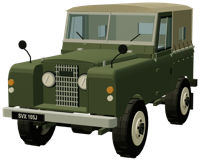
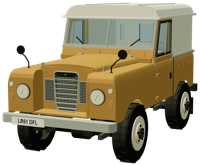
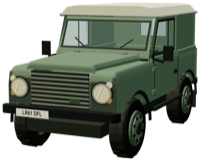
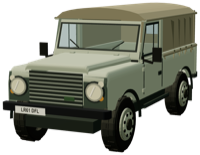
Toyota's four-wheel drive began as the Jeep BJ of 1951, built for the National Police Reserve, and became the Land Cruiser in 1954 when Willys objected to the name. The 20 Series of 1955 gave it the F six-cylinder engine; the 40 Series of 1960 gave it the body, the two-speed transfer case and the range of wheelbases that carried it for a quarter of a century. Leaf springs and beam axles front and rear, a steel body on a ladder frame and the 3.9-litre F (4.2-litre 2F from 1975) made it heavier and slower than a Series Land Rover, and more durable.
Australia, where the first Land Cruisers went to the Snowy Mountains Scheme in 1958, became the model's largest market outside Japan; the long FJ45 pick-up and troop carrier and the diesel HJ45 defined the outback fleet. In the United States the FJ40 sold from 1960 to 1983 and the FJ55 wagon beside it. The 70 Series took over the working role in 1984 and the 60 Series the wagon; the Brazilian Bandeirante, a 40 body on Mercedes-Benz and later Toyota diesels, ran on to 2001.
From the Jeep BJ to the 40 (1951–1960)
2 VEHICLES IN THIS CHAPTERThe Jeep BJ of 1951 put Toyota's 3.4-litre B engine in a light truck chassis for the police and the National Safety Forces; the Land Cruiser name followed in 1954, and the 20 Series of 1955 brought the F engine, softer styling and the first exports. By 1960 Toyota had a new body ready with a shorter bonnet, a two-speed transfer case and a three-speed gearbox: the 40 Series.
Registry records · chapter 1

The F-engined years (1960–1975)
3 VEHICLES IN THIS CHAPTERThe FJ40 short wheelbase (2,285 mm) was sold as a soft top and a hard top; the FJ43 medium (2,430 mm) mainly for export; the FJ45 long (2,650 and 2,950 mm) as a pick-up, cab-chassis and, from 1967, the FJ45V four-door wagon. A four-speed gearbox replaced the three-speed in 1974, disc front brakes arrived in 1975, and the H six-cylinder diesel (HJ45) was offered from 1972 for markets that wanted one.
Registry records · chapter 2
2F, diesels and the end of Japanese production (1975–1984)
2 VEHICLES IN THIS CHAPTERThe 4.2-litre 2F of 1975 and the B-series four-cylinder diesels (BJ40, BJ42) of 1974–84 carried the range to its end. Power steering and, in the last years, a five-speed gearbox were added; the United States range ended in 1983 and Japanese production in 1984, when the 70 Series took over the utility role and the 60 Series the wagon. In Brazil the Bandeirante, built from CKD kits since 1958 and with the 40 body from 1968, continued on Mercedes-Benz OM-314/OM-364 and then Toyota 14B diesels until 2001.
Registry records · chapter 3
Base models
The structural configurations the registry and the Creator build from; each page carries the researched specification.Sources
- Toyota Land Cruiser (J40) — Wikipedia
- Toyota Land Cruiser — Wikipedia