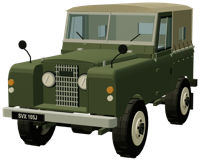
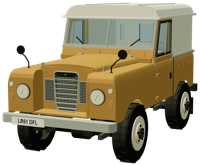
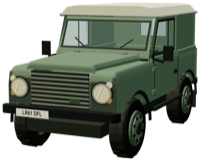
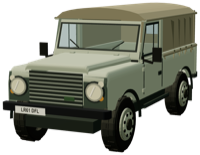
The 60 Series replaced the FJ55 in August 1980 as a five-door wagon with air conditioning, a proper heater and a quieter cabin, aimed at the growing North American and Australian market for a family four-wheel drive. Underneath it kept the leaf-sprung, solid-axle layout of the 40 and 55 with the 2F petrol six or the 2H and, from 1985, the turbocharged 12H-T diesels.
The FJ62 of 1988 brought the 3F-E fuel-injected engine and a four-speed automatic for North America, where the 60 Series was the only Land Cruiser sold. Toyota passed one million Land Cruisers in 1981, during its run. The coil-sprung 80 Series replaced it in 1990; Venezuela assembled the 60 until 1992.
FJ60 and HJ60 (1980–1987)
1 VEHICLE IN THIS CHAPTERThe FJ60 carried the 4.2-litre 2F with a four-speed gearbox; the HJ60 the 4.0-litre 2H diesel, the choice of Australia and the Middle East. Both had leaf springs, drum rear brakes and a split rear tailgate; a five-speed gearbox arrived in 1985.
Registry records · chapter 1

FJ62 and HJ61 (1987–1990)
2 VEHICLES IN THIS CHAPTERThe FJ62 of late 1987 had square headlamps, the 4.0-litre 3F-E with electronic fuel injection and a four-speed automatic, the first automatic wagon Land Cruiser in North America. The HJ61 took the 12H-T turbo-diesel. Japanese production ended in January 1990.
Registry records · chapter 2
Base models
The structural configurations the registry and the Creator build from; each page carries the researched specification.Sources
- Toyota Land Cruiser — Wikipedia
- 75 Years of Toyota — vehicle lineage — Toyota Motor Corporation
- Toyota Land Cruiser (J60) — Wikipedia