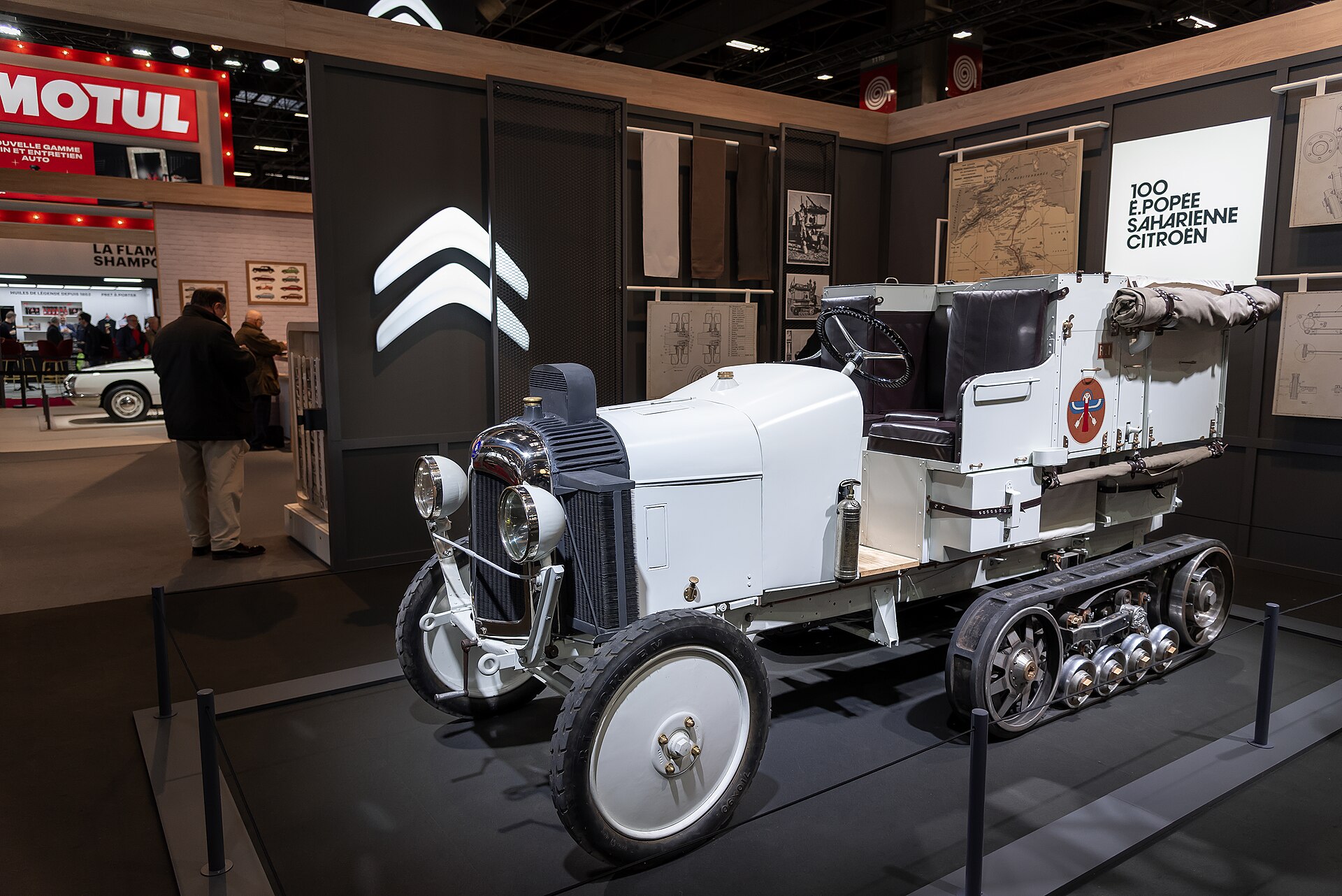
The most numerous Citroën half-track: the P10 of 1928 on B14 parts with a 1,539 cc four, and from 1930 the P17 on the C4 with a 1,628 cc four, later 1,767 cc in the P17 C, D and E. 191 P10s and 927 P10-1929s were built, and 1,442 P17 artillery tractors served the French Army.
MODEL LINEKégresse C4 and C6BUILT BYCitroënPRODUCED1928–34OPERATED INFrance, Poland, PortugalPRODUCTION191 P10, 927 P10-1929LAYOUT2 wheels
The record
The P17 towed the French 75 mm field gun and the 47 mm and 25 mm anti-tank guns, and carried troops, signals and ammunition; the P17 bogie was the pattern for the P14, P19 and P107. Six P17s went with the Pamir group of the Croisière Jaune in 1931 and five P17 Ds with Charles Bedaux into northern British Columbia in 1934. Poland took about a hundred P14s, P17s and P19s between 1931 and 1933; the US Ordnance Department tested one, and James Cunningham, Son & Co bought the Kégresse patent and built the T1 half-track in 1932. The Germans took captured P17s into service in 1940 as the Zugkraftwagen Ci 301 (f).
PRODUCTION RUN191 P10, 927 P10-1929; 1,442 P17 in French service
COUNTRY OF ORIGINFrance
OPERATED INFrance, Poland, Portugal
STATUSout of production; succeeded by the P107
RECORD KINDBase model
MODEL LINEKégresse C4 and C6
FAMILYKégresse C4 and C6
WHEELS2
BODY STYLEArtillery tractor
VARIANTS2
Catalogue fields describe the vehicle's structure and body as this registry records it. They are not certified factory measurements, and no performance figures are published here.



.jpg)